From the read-only archive of the Wardley Mapping community forum (2018–2023). Category: Share your map. Posts are by their authors. Links to sites that moved or closed point to link notes.
jesper ·
Hey,
My name is @jesper. I work in the IT services industry, as Senior Test manager primarily for the enterprise and public sectors. My specialties are RPA, SME-based testing and test strategies.
I have been following the works of Simon since 2012 incl. the original blogposts. I have recently started mapping test strategies, and see a huge potential and I’m experimenting, as it is novel. 😉
If the testing activity can be integrated into the coding activity, who tests if there is no code involved? Does there have to be code in order for there to be a test activity – and when does…
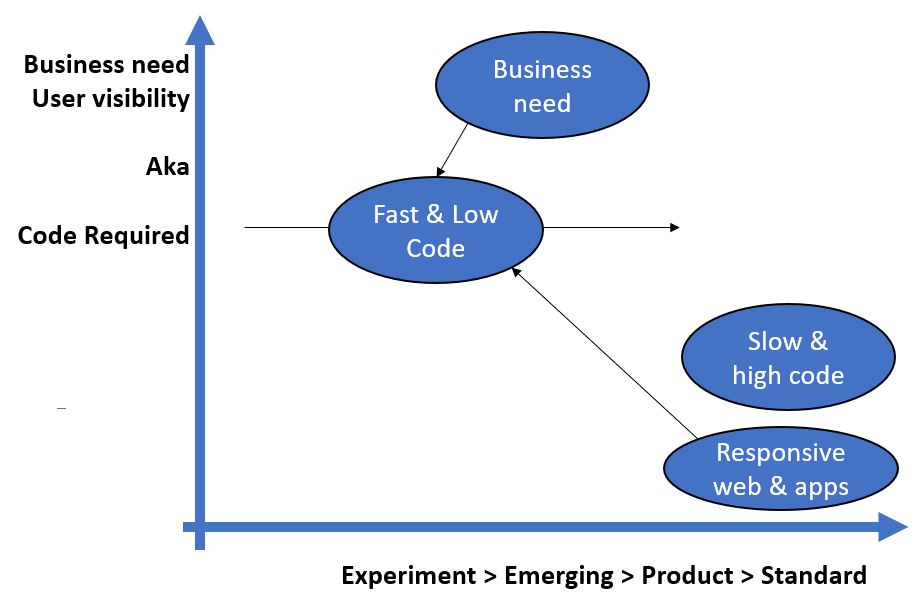
It shows that: Low code automation tools (RPA) builds on responsive web apps to deliver more user visible services. The current stage is emerging. Also it competes with “high code”.
If I had run business in this field, I would do focus innovation on low code/no code tools for fast customer visible automation efforts.
I would like to discuss this map.
Best regards,
@jesper
chris.daniel ·
Hi @jesper,
thanks for this article. Have you had a chance to think about future effects of low code and whether there is a chance that Jevons will kick in and support creating tons of difficult to maintain solutions?
rsinnema1 ·
Your map shows a single “Business Need”. I think there are different types of business needs, some of which can easily be met by low code systems, where others (currently) can only be met by “high” code systems.
The software development industry has a long and troubled history proclaiming the end of programming as we know it. Call me skeptical.
john.grant · · 1 like
I agree. Low code will always be domain specific. Domain specific languages will be increasingly useful, but third-generation programming languages (3GL) provide the requisite variety to design and implement novel solutions.
These drivers probably to make the barrier to entry seem more manageable. The visual ones very easily turn into visual spaghetti code if you don’t keep an eye on it and use sub flows, low coupling and high cohesion [13]. … as with any other non-trivial code (of a certain McCabe complexity [14]). One interesting way to go about a “coding” practice for visual test cases could be inspired by how BDD can be implemented in LeapWork(link note) [8] with annotation and self-referencing unit tests.
At the end of the day even a visual test automation project is a coding project, that should be part of the project code base like everything else [3]. And probably best maintained by software engineers within the project team (where possible) – unless you want a team of test engineers spending all day playing catch-up to maintain the automation code.
Among the currently shiny new test automation things are visual “script-less” test automation tools. But the visual test flows are still code – and thus require discipline to stru…
jesper ·
hi @rsinnema1
Appreciated!
rsinnema1:
Your map shows a single “Business Need”. I think there are different types of business needs, some of which can easily be met by low code systems, where others (currently) can only be met by “high” code systems.