A common problem reported by new adepts of mapping is their lack of trust in their newly acquired skills. No wonder, it is pretty natural, since confidence stems from repeated execution. More, only in the case of repeated execution it can be called confidence, as in other cases it is just arrogance.
The true challenge comes a little bit later, as in the plenty of situations, there is an objective scale that can be used to assess the quality of our skills.
- If you are learning how to drive, it may be the number of accidents and the number of people you made upset when commuting.
- If you are learning a new language - it may be whether you can or cannot communicate in it.
The mapping, however, is different, as it relies on modelling the reality, and the problem is that all models are generalizations that are useful from time to time.
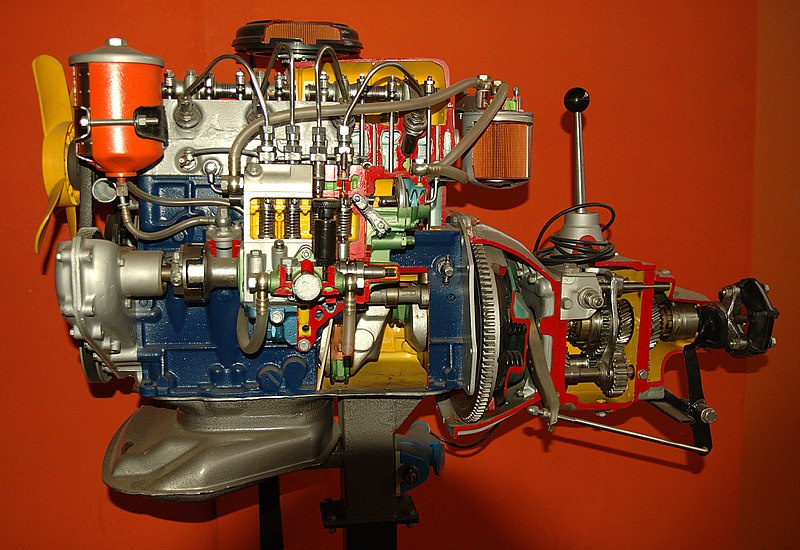
This model of an engine is useful for some purposes (like teaching), but completely useless for others, such as actually powering something. Photo by Luc Viatour.
A perfect representation of a building is the exact building, and it is of the size of that building. Only after we are ready to give up some unimportant-in-the-given-context info, like f.e. wall textures, we can start thinking about making a smaller representation which will be more useful for purposes we have defined upfront, such as easy navigation within the building.
That said, the model is right only if it is useful, and it is useful only if it is right, and there is always a heavy compromise involved between fidelity and usability. There is no universal measure, no scale that allow for grading the usefulness quality of a model in every possible context, as in every contexts, focus is on different things.
It is like with the evolution. It is about survival of the fittest, but the question is, how do you identify those ‘fittest’? Fastest? Strongest? Most resilient?
No!
Fittest are those that survive, and those that survive are the fittest. The loop closes.
That said, the quality of a model is determined only by how useful it is for given purposes.
In the world of mapping, this bit of knowledge simplifies a lot of things, amongst which is the process of creating an initial map. The focus is no longer on getting things accurately, but mostly about avoiding significant mistakes, and the two major groups of those are:
- failure to distinguish components at different levels of Evolution - (bias), especially if your component is not as mature as your competitors one. It will not only hamper your efficiency (in the best case) or prevent you from reacting to disruption (in the worst), but will also undermine your ability to anticipate what is next.
- failure to understand factors that contribute to your situation. It is not a problem with your map, as you can map only what you understand, but it is a fundamental misunderstanding of your environment, which can be corrected only by showing your map to others and allowing others to challenge it.
Therefore, challenging a map is the most important aspect of mapping, as it is the only way of figuring out what you do not know, and what you do not know, you do not know. This is the process of reconciling dispersed, incomplete and contradictory knowledge that we all have in our minds.
When you are creating a map, especially your first map, do not worry about nuances. If you do not know whether something is closer to a Product or an Utility, drop it between and move on. It really does not matter! The only important thing is whether you will be able to draw appropriate conclusions about your situation!
And to determine whether your conclusions were right, you need to have them challenged, take decisions, execute them and review the results. Only then will you know.
That said, as of today, I find mapping to be an auxiliary process of visualizing my perception of the reality, which sometimes help in adjusting how I view things.
Edit: typos & grammar, thanks @john.grant!