From the read-only archive of the Wardley Mapping community forum (2018–2023). Category: Microdoctrine · #learning · #theory. Posts are by their authors. Links to sites that moved or closed point to link notes.
tristan.slominski ·
This is a Request For Comments about how to structure doctrine in terms of microdoctrine (a pattern language for implementing and learning doctrine)
Phase: Stop Self Harm Category: Development Principle: Focus On User Needs
Motivation:
Any value we create is through meeting the needs of others. A mantra of “not sucking as much as the competitors” is not acceptable. We must be the best we can be. [source]
Illustrative description:
The first thing to do is to understand that you’re talking about user needs not your needs. You might need to make revenue and profit but that is NOT your user need. Meet the needs of your users, then hope to make revenue and profit, not the other way around.
I am of mind that whatever way most effective for you to Focus On User Needs, that way should be the way. The content here, is a way to accomplish Focus On User Needs, but not the way. The main idea being that practices here are something to get started with.
I think it would be perfectly valid to add another Practice that is based on Alex Hudson’s work along the lines of Customer Journey Maps → Mind maps.
orengolan ·
I see a bunch of posts with similar titles (Phase x - y). Can someone explain what’s going on here? Are we working on some Wardley Maps book and @tristan.slominski is looking for feedback? if so, where can I read it?
Thanks!
tristan.slominski ·
Hi @orengolan,
Yes, looking for feedback. No, I wasn’t thinking of a book 🙂 .
I wanted to experiment with the structure of doctrine. I hoped that I could structure it to make it easier to learn and adopt. I want to be able to assess my level of doctrine adoption. And, if I am adopting doctrine, I want to know what I should adopt next. With these goals in mind, I set out to create a doctrine format that breaks up doctrine into small pieces. I call this microdoctrine .
i’ll take a look at the resources you linked to. Thanks!
orengolan · · 1 like
thanks for the short and concise video! watching it helped me understand your motivation. I noticed that you only have doctrines for phase 1. are you planning to add more? Also, I wonder if it’s better to have it on a website instead of this forum since many people won’t discover it. maybe even collaborate with Ben and host it on https://learnwardleymapping.com/? just an idea to think about.
chris.daniel ·
orengolan:
maybe even collaborate with Ben
linking @bemosior into the discussion
bemosior · · 2 likes
Thanks for the suggestion, @orengolan! And thanks @chris.daniel for the ping (apologies for the duplicate accounts… I must have gotten confused during the auth transition… if you want to delete @bemosior that would be fine).
@tristan.slominski here are the capabilities I can offer to you:
tweets from HiredThought (I can work with you and my admin to schedule an extended series of tweets highlighting your account and your work)
mailing list posts (I can probably get about 60 people to click a link for any given post)
guest blog posts on LWM (we could probably get about 60 organic views on something, probably a couple hundred if we tweet it and use the mailing list)
If the world reacts with interest, I’d also be open to:
helping you build a course (my time + admin help), which would get you some $ and invested users (yes you can do this while simultaneously releasing cc by sa)
carving out a section on microdoctrine on the website, handing you the keys to run it, as well as support from my admin to keep eyeballs on it as you make improvements. (caveat being… we’d need to make sure you’re getting something from it, be it follows on twitter or affiliate commission on my course sales or something…)
Weird thoughts incoming…
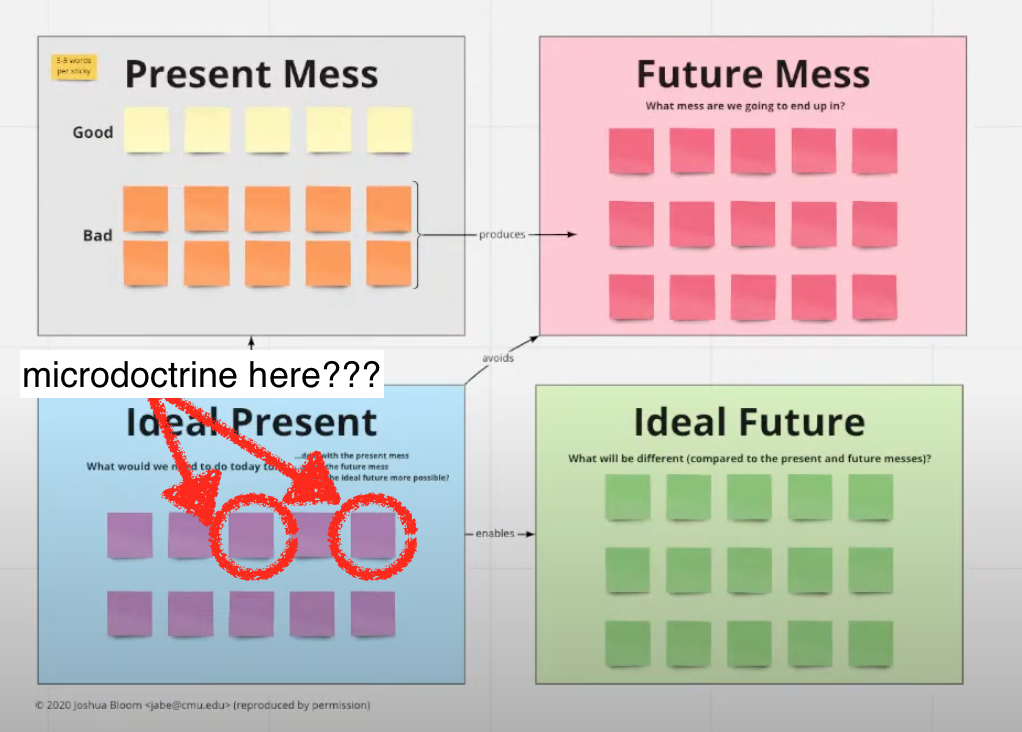
Can’t believe I didn’t think of it until now, but it would be super interesting to apply the Ideal Present canvas to microdoctrine concerns… potentially as a diagnostic framework for users.
A likely story…
“Hmm, I’m supposed to learn doctrine.”
“Guess I’ll start with ‘focus on user needs.’”
“Present Mess: Here’s the good parts of how we focus on user needs. But then there are a lot of bad parts, too. For instance, we don’t ever talk to our customers.”
“Future Mess: Well, if we don’t talk to users, these bad things might happen.”
“Ideal Future: We talk to users all the time. We understand their needs. We don’t do exactly what they say, but we have good judgement about what to act upon.”
“Ideal Present: These babystep practices from microdoctrine… E.g., ‘What does it take to talk to ONE user?’”
or at least that’s how my brain works on this…
chris.daniel · · 2 likes
@tristan.slominski @bemosior
I think you are both on something significant.
I am a big fan of the ‘Ideal present’ concept, and this is where Microdoctrine seems to be coming along - it allows you to find your next stone while crossing the river.
The challenge is that Simon avoids defining Doctrine practices more precisely, and he seems to believe people should take action based on their feelings about how well doctrine principles are implemented.
What I think could be of tremendous value is finding use cases in the community and gathering stories about implementing Doctrine principles.
Imagine: ‘Know your users’:
We have built an internal platform that is not widely adopted even inside our organisation. (Observation)
Frankly, we do not know why. This goes against the ‘Know your users’. Ouch! (Diagnosis)
We will interview ten potential customers and ask them about their situation and what they need to adopt our platform. (Action)
On the other hand, I am very afraid that existing Doctrine practices are too rich to be contained in this way 🤔. But I will certainly pay more attention to how people evaluate their existing state and how they turn that evaluation into practice .
I am just thinking loudly, so feel free to call it all rubbish, no offense will be taken .
tristan.slominski · · 1 like
I can imagine an Ideal Present Canvas for each Doctrine… and perhaps microdoctrine are the little pieces that help bring about ideal present??
bemosior ·
Ooooh yes! I tried something similar with a team recently, and I liked what actions they discovered were immediately possible.
orengolan ·
I never used the Ideal Present Canvas but would love to learn more. if anyone has good practical resource or examples, please share them!