
Is there a definition of ‘Capabilities’? When to treat them just as a component (one of many) on the map vs. when is it useful to distinguish them from other components?
Questions, Answers & Random posts
Mapping Glossary
· Updated
From the read-only archive of the Wardley Mapping community forum (2018–2023). Category: Questions, Answers & Random posts · #theory. Posts are by their authors. Links to sites that moved or closed point to link notes.
This might help. It’s from the second paragraph before Figure 17 in https://medium.com/wardleymaps/finding-a-path-cdb1249078c0
You will regularly come across components that parts of the group feel passionate about. They will declare it as unique despite the fact that all your competitors will have this. There is also the danger that you will describe the component by how you treat it rather than how it should be treated. . . There are many causes for this, some of which are due to inertia and the component being a pet project and in other cases it is because the component is actually multiple subcomponents. In the latter case, you’ll often find that most of the subcomponents are commodity with maybe one or two that are genuinely novel. Break it down into these subcomponents.
In other words, when comparing several maps or exploring a map, and there’s not much disagreement about which stage of evolution a component is in, then treat it as any other.
If there’s much disagreement - some say it’s commodity while others say it’s custom, then break it down into sub-components. Some subcomponents might be commodity but some might be in custom.
I’m intrigued about the Simon Says Alexa skill.
It’s a project and one likely to provide an increasing awareness of wardley mapping. It could be quite consuming. Could it be done as a community effort perhaps allow contribution via the wardleypedia wiki?
For audio you want to chop up sound bites from his many videos. Again can this be automated so community members contribute their favourite quote?
And could we we create a chatbot, too?
I’m fascinated by them. I have worked in teams using chat bots where clever developers integrate their build tools into commands in their messaging system.
Telegram has millions of technical people and really comprehensive chat bot integration.
Oh, too many things to do and not enough time.
elves:
It’s a project and one likely to provide an increasing awareness of wardley mapping. It could be quite consuming. Could it be done as a community effort perhaps allow contribution via the wardleypedia wiki?
If I remember correctly, this tool was created by Drew Firment. I would ask him about his opinion here :).
https://twitter.com/drewfirment
hello,
couple of weeks ago, on the Friday chat Simon commented that you should try to play “First mover” when you are moving from Product → Utility. And “Fast follower” when moving from Genesis → Custom Build.
s there any relevant gameplay we should pay attention when moving from custom build-> product?
(it’s assumed that the player is in that given context and is competing there)
many thanks in advance
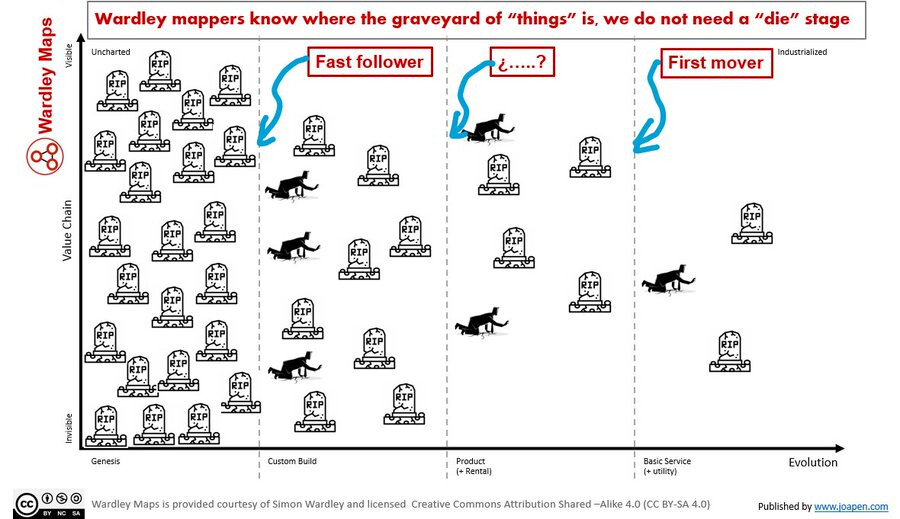
That’s a super interesting question. I am tempted to say it doesn’t really matter, as the market starts growing, so it is ok if only you manage to join the overal trend early.
I agree and disagree.
I agree, it does not matter.
I disagree, I would like to point to the capabilities a company or organization should have to benefit of that climatic pattern. Companies or organizations that have the relevant capabilities to benefit of that growth.
For instance, you could be using sensing engines to detect that growth, and then acquire one relevant player on that field. That could be a gameplay.
joapen:
I disagree, I would like to point to the capabilities a company or organization should have to benefit of that climatic pattern.
That’s a fair point. I am currently unaware of any specific practices other than building generic situational awareness, scanning the market for competitors (however small they are) and perhaps trying to pull off the ILC model (if you are a provider of utility services in some field).
The situational awareness could be automated to some extent, because products must be advertised:
- identify expensive, custom-built projects (easy, people brag about them)
- imagine products giving the same output, identify keywords that could be used
- watch for ads announcing new products matching the keywords
- evaluate the maturity of products
That looks like a good product idea 😃
thank you so much for your answer Krzysztof, all interactions are useful, as you never know where the right direction is.
Right, use of tool such google trends or google analytics right now gives you a lot of data that can be used to track behaviors and try to identify trends.
cheers!
It also depends if you’re “attacking” or “defending”. The table that @tasshinfogleman [1] created also categorizes the Gameplays - the “attack” and “defend” categories are a good starting point.
[1] - search this page (Keyboard shortcut Ctrl+F) for “@tasshinfogleman” and follow link to Google sheet.