From the read-only archive of the Wardley Mapping community forum (2018–2023). Category: Share your map. Posts are by their authors. Links to sites that moved or closed point to link notes.
john.grant ·
It has intrigued me that automation is not more prevalent in the legal profession than it appears as an outsider. Natural language processing, statistical analysis of case law and machine learning for building models to predict judicial decisions would seem an effective way of improving access to justice.
Training data is needed for machine learning. Explainable AI and ethics require careful attention. Moreover, it would be cynical of me to work on the assumption that lawyers are too preoccupied with legal professional privilege and profit maximization to be distracted by disruptive innovation.
Before I dig a deeper hole, I will instead focus on in-house legal departments. In particular, effective collaboration between general counsel, legal service providers and legal automation.
Which legal areas are suited to automation? Rob Booth, a co-founder of The Bionic Lawyer Project, has created a model in which legal problem-solving can be defined by two categories:
Silver box problems are characterised by being:
Rules based
Stable and predictable
Repeatable
Scalable
Gold box problems are characterised by being:
Complex, multifaceted and ambiguous
Unpredictable and uncertain
Rapidly changing or chaotically decaying
Impacted by irrationality, emotion, dishonesty and bias
The two categories seem to map to the Cynefin domains. The silver box represents the clear and complicated domains, whereas the gold box represents complex and chaotic. In terms of aptitudes, there is some alignment with Wardley PST. What became clear as I began to map this space is that lawyers of the future will be more proficient in data analysis.
Uncertainty and rapid technological change means that, as enablers, legal departments should avoid creating isolated silos but integrate into the existing business tech stack instead, with access to corporate and operational data as required. The latter is already becoming industrialised through cloud monitoring and observability.
We should therefore be able to anticipate consolidation of legal service providers operating in the silver box category. Outsourcing silver box problems should become the norm as it will reduce costs and increase efficiency. Providers who can acquire the most data and extract the most value are likely to be those that invest most in innovation. So why not look at consolidating some services in the gold box too? Law firms pooling resources and sharing data to build more effective tools and better performing prediction models could become formidable players. AWS Robot Lawyer as a Service, perhaps?
I would expect a development similar to the centaur chess, where AI or rules help to bring relevant knowledge but it is always a human that makes a decision because computers do not understand the real life nor the external environment.
The concept of robolawyer is a very tempting one, but I do not think any law firm will pool resources. My understanding is that they do not want even to stanrdise common legal letters as it would reduce time necessary to write them.
However, RobotLawyers going through consumer agreements and issuing warnings… that would super interesting.
jesper · · 1 like
Thank you for the map John, it does illustrate some general trends. 🙂
chris.daniel:
I do not think any law firm will pool resources. My understanding is that they do not want even to stanrdise common legal letters as it would reduce time necessary to write them.
That’s an issue I see wrt other activities on time & material. The producer of “silver box problems” on T&M is not significantly incentivized to “convert” due to sunk costs, etc. They will of course be looped around eventually, because it’s a purely cultural block.
The human brain is a complex organ with the wonderful power of enabling man to find reasons for continuing to believe whatever it is that he wants to believe.
yours Jesper
john.grant · · 1 like
Thank you for your comments @chris.daniel
I am reminded of Thomas Malone’s Superminds in relation to your centaur chess comment.
Not sure I totally agree with your thoughts on pooling resources. By the time law firms have evolved into legal service providers, scaling will be an important factor. They will have essentially evolved into data collection and processing businesses.
Charging for word template letters by post, even face to face consultations, will have become legacy legal practices. Acquiring diverse data will be the priority.
mark ·
I’ve previously seen a suggestion that a traffic, parking tickets, speeding tickets and other minor matters will be automated.
I also can imagine automating checks, perhaps even tools that find relevant case law based on more than just text search. - Mark
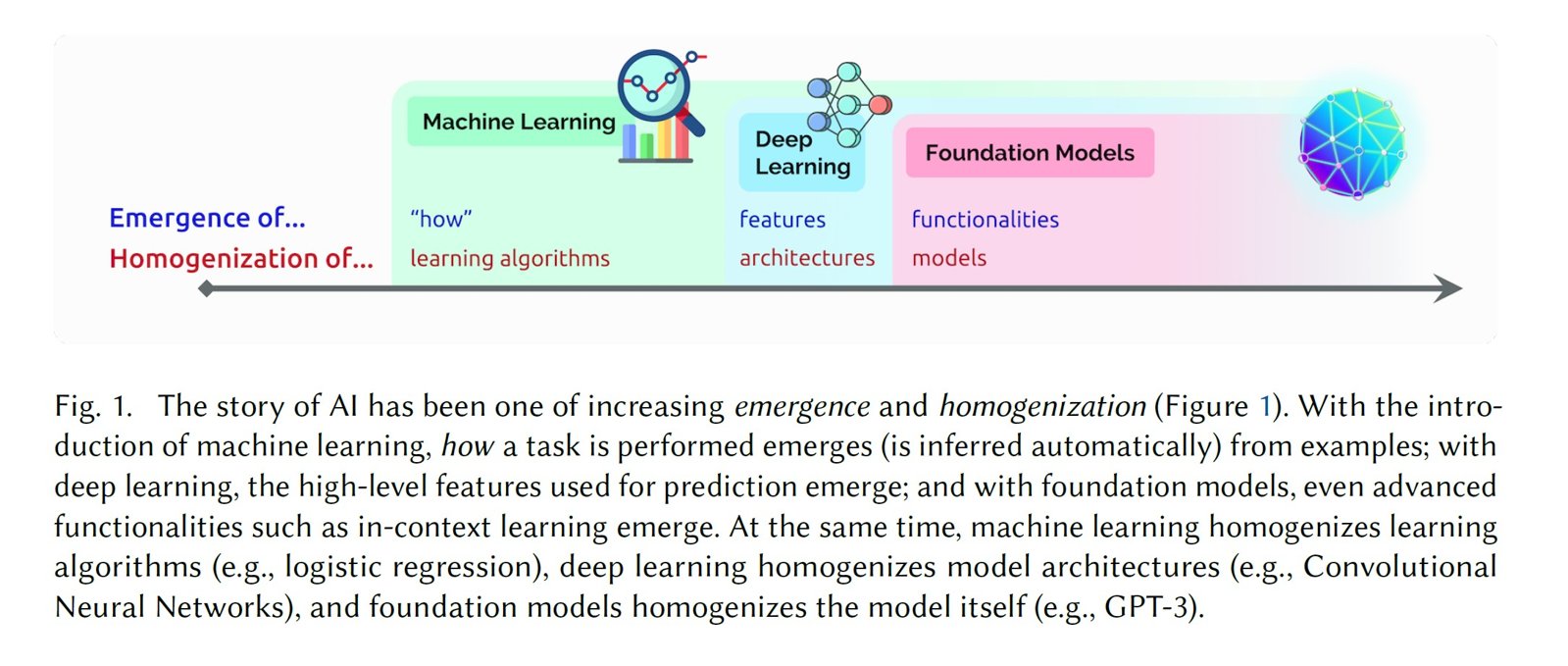
AI is undergoing a paradigm shift with the rise of models (e.g., BERT,
DALL-E, GPT-3) that are trained on broad data at scale and are adaptable to a
wide range of downstream tasks. We call these models foundation models to
underscore their critically...
chris.daniel · · 1 like
@john.grant,
thanks for this article.
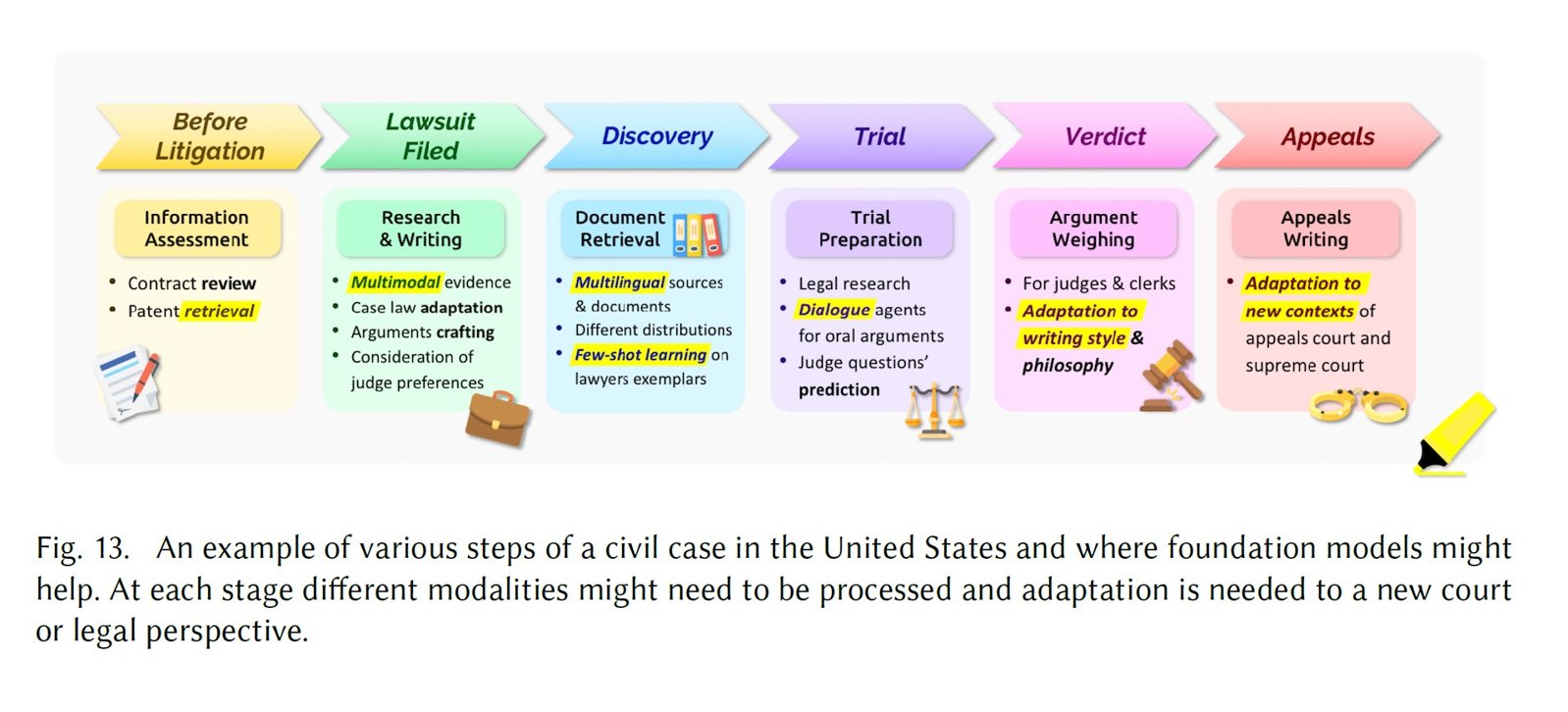
If I understand AI correctly, it works on the symbol association level - it can figure out that certain words go well together or can be replaced in a given context, but it cannot understand the meaning, whatever that means. Therefore, at least the first part of my comment needs to be sustained, and the figure that you have pasted seems to support it - note that opportunities for AI are mostly about language manipulation, not the merit of the case.
This has serious consequences - if lawyers already spent 80% of work (I am guessing) playing with words and only 20% crafting the meaning, then AI can considerably improve lawyers performance. It will work for silver and gold box problem in the same way. The Silver box may be affected a little bit more, though.
Lawyers are very likely to embrace those solutions because of the efficiency gains. Then we will hopefully get fiercer competition, prices will go down and the race for efficiency will begin. Eventually :D.
Up to this point, we are talking only about Centaur Lawyer.
But if Centaur Lawyer does change the market, Silver Box problems may get automated even further, and we can get robotic lawyers for certain types of problems (I believe we already experience those when we deal with automatic insurances).
@john.grant had I lower base costs, this would be a good hill to fight for: handing laws back to citizens.
john.grant ·
My interest in the application of AI in law goes beyond NLP and topic modelling. For example, in the context of general counsel, AI driven due diligence will apply ensemble approaches to detect patterns, predict trends and assess risk.
I suspect there are several forces at play that will alter the trajectory beyond the notion of a “Centaur Lawyer”. These are hyperconnectivity time constraints, higher-order REPLs, and zero marginal cost.
In the hyperconnected age, the volume, velocity, and variety of data generated by the activity of autonomous economic agents will necessitate affordable legal automation. AI will enable time constrained decision-making.
Current RobotLawyer technology offers limited UX. As the OpenAI Codex video demonstrates, chatbots are evolving rapidly into higher-order REPLs. In a corporate environment these interfaces will enable new forms of what-if analysis. Instead of offering advice in a single discipline, such as corporate law, they will act as interdisciplinary intuition pumps.
In terms of civil law, I suspect zero marginal cost of open source federated ML models will indeed lead to greater access to justice.